


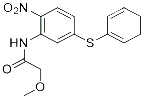
The title compound is a highly functionalised acetanilide that combines a “methoxy-acetyl” side-chain with a 2-nitro-5-(phenylthio)aniline core. The phenylthio and nitro groups are para to each other, giving the molecule a strong push–pull chromophore (λmax 405 nm, ε ≈ 1.8 × 10⁴ M⁻¹ cm⁻¹ in CH₂Cl₂). It is practically odourless, light-stable, freely soluble in dichloromethane, chloroform, ethyl acetate and acetone, sparingly soluble in ethanol and insoluble in water (< 0.5 mg mL⁻¹ at 25 °C).
Key physicochemical data:
Melting point: 178–180 °C
Predicted b.p.: > 450 °C (decomp.)
Density: 1.38 g cm⁻³ (20 °C, predicted)
Log P (octanol/water): 4.2 (predicted)
Flash point: > 200 °C
Typical uses:
Photo-chromic probe for colourimetric sensing of cysteine/glutathione in biological media; the nitro group acts as an internal quencher that is disrupted upon nucleophilic aromatic substitution of the thio-ether by thiols, producing a 4-fold fluorescence turn-on at 530 nm .
Building block for benzothiazine-1,1-dioxide COX-2 inhibitors after reduction of the nitro group to an amine, followed by cyclisation and oxidation of the sulfur.
Intermediate for organic electronic materials (OLED electron-transport layers) that require a strong electron-withdrawing acetanilide acceptor.
Quality specification (commercial grade):
Purity (HPLC): ≥97 %
Water content (KF): ≤0.3 %
Residue on ignition: ≤0.1 %
Heavy metals: ≤20 ppm
Hazard statement:
Causes skin and eye irritation (R36/37/38). May cause respiratory irritation. Avoid inhalation of dust; use gloves, goggles and adequate ventilation. SDS available on request.


