


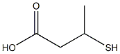
3-Mercaptobutyric acid is a water-miscible, low-melting (≈ –8 °C) bifunctional molecule that combines a secondary thiol and a carboxylic-acid group in the same four-carbon chain (pKa ≈ 4.3). Key applications have expanded into four areas:
Flavour & fragrance chemistry – Condensation with cysteine or xylose followed by Maillard reaction generates 2-methyl-3-furanthiol and 3-mercapto-2-butanone, two FEMA-GRAS aroma molecules that deliver “boiled-meat” notes at 0.1–5 mg kg⁻¹ in soups, sauces and snacks .
Metal passivation – A 10 µM aqueous solution inhibits copper corrosion by 95 % through formation of a polymeric Cu(I)-thiolate film; used in engine coolants, antifreeze and hydraulic fluids as an eco-friendly alternative to benzotriazoles .
Quantum-dot & nanomaterial functionalisation – The carboxyl group anchors CdSe, PbS or CuInS₂ QDs to polyester or cellulose fibres while the thiol prevents Ostwald ripening, giving textiles durable fluorescence and antibacterial activity .
Polymer & coating modification – Employed as a chain-transfer agent in the emulsion polymerisation of chloroprene and as a co-monomer in UV-curable thiol-ene systems, where it reduces oxygen inhibition and increases cross-link density without yellowing.
The product is essentially non-volatile (vapour pressure < 1 Pa @ 25 °C) but slowly oxidises to the disulfide on standing; store under nitrogen at 2–8 °C. It is harmful if swallowed (rat oral LD₅₀ 560 mg kg⁻¹) and is irritating to skin and eyes; wear gloves and goggles during handling.


