


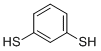
1,3-Benzenedithiol is the simplest aromatic vic-dithiol in which two thiol groups are meta to each other on the benzene ring. The compound crystallises at 24–26 °C and boils at 245–247 °C (760 mm Hg) with a refractive index n²⁰D = 1.641. It is virtually insoluble in water but dissolves readily in common organic solvents (EtOH, Et₂O, CH₂Cl₂, DMF). 1,3-Benzenedithiol is a versatile building block in supramolecular and materials chemistry. Deprotonation with NaOEt generates the dianion that reacts with α,α'-dibromo-o-xylene to give the meta-bridged tetrathia[7]metacyclophane, a useful host for Ag⁺ and Hg²⁺. Under aerobic conditions and Cu(I) catalysis the molecule undergoes oxidative 1,3-benzenedithiolate polymerisation to yield poly(phenylene-1,3-disulfide), an amorphous high-index (n = 1.74) plastic that transmits from 450 nm to 8 µm and is being evaluated as an IR lens material. The dithiol is also employed as a chain-transfer ligand in the synthesis of water-soluble CdS and PbS quantum dots capped with a meta-dithiolate shell, giving particles with narrow band-edge emission (FWHM < 25 nm) and excellent colloidal stability at pH 7–10. Because both –SH groups are strongly nucleophilic, the compound is an efficient scavenger of soft metal ions (log β₂ for Hg²⁺ = 28.3); consequently it is formulated as a colourimetric sensor for mercury in drinking water (detection limit 2 ppb). 1,3-Benzenedithiol is moisture-sensitive and slowly oxidises to the cyclic disulfide on standing; it should be stored under nitrogen at 2–8 °C. Inhalation of the vapour causes headache and nausea; the oral LD₅₀ in rats is 98 mg kg⁻¹.


